Microplastics and your water bottle: what the material choice changes
Why microplastics in drinking water keep making the news, where they come from, and what that means for the bottle you drink from.
Written and source-checked by the Kopero editors · Updated November 7, 2026

Why this subject is not going away
Microplastics in drinking water have been in the news regularly for several years. Studies of bottled water have repeatedly found particles in it, and every time the measurement method improves the count goes up, because smaller particles become visible that used to slip through. That makes it a subject you have to reckon with when buying a water bottle.
In short
- Microplastics reach drinking water through the source and through the packaging.
- A plastic bottle wears: scratches, heat and sunlight speed that up.
- A bare metal wall has no plastic lining to wear down.
- Check the inside too: plenty of metal bottles do have a plastic coating.
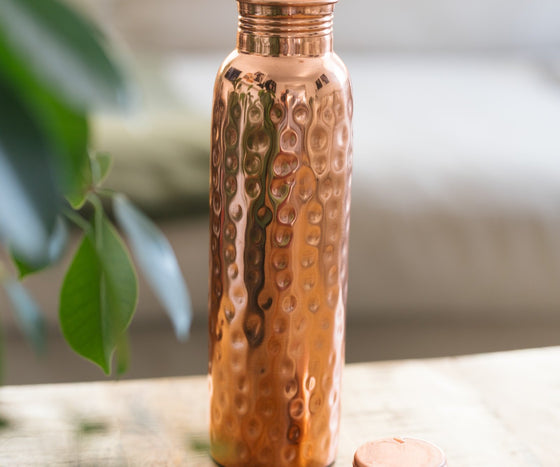
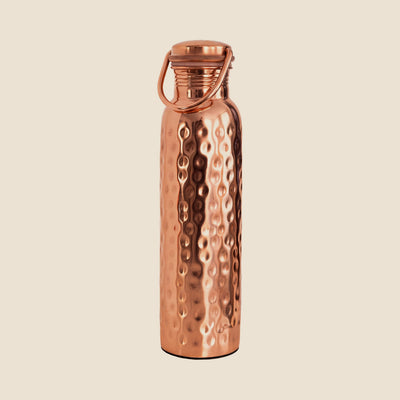
- Our bottle is solid copper with no inner lining.
Where it comes from
There are two routes. The first is the water itself: microplastics are by now in surface water, in soil and in the air, and some of that ends up in the water chain.
The second route is the packaging. A plastic bottle wears down through use: every scratch, every wash and every time it lies in a warm car or stands in the sun speeds that up. The bottle itself slowly becomes a source.
Check the cap too
A bare metal wall has no plastic lining to wear down. The material of the cap and seal matters too, as does where the water comes from.
Look beyond the bottle itself. Researchers at France’s ANSES linked microplastic particles in some glass-bottled drinks to the paint on metal caps. The cap deserves as much attention as the inner wall.
Plenty of metal water bottles have a coating on the inside, often plastic or epoxy, to keep flavours from transferring. Then the outside is metal and the side touching your water is not. That is exactly the question to put to a seller. How to establish things like that about a bottle is in how to recognise real copper.
Why water touches the copper itself
Ours has none. The copper you see on the outside is the same copper your water touches: solid, independently measured at 99.21% (RTC 2021) purity and tested against the European food-safety standards. In the test for nineteen heavy metals not one was detected. The full measurement is in what our copper products are made of.
Leaving the copper bare is exactly what you want: your water touches the metal itself. That is why it tarnishes, and half a lemon with some salt (salt crystals can be mildly abrasive, so let the salt dissolve completely in the lemon juice before polishing) polishes it back. What that means in practice is set out in benefits and drawbacks.
The comparison in short
Plastic is light and cheap and it wears. Stainless steel is strong and neutral, but it is inert: it does nothing of its own accord, and there is often a coating on the inside anyway. Copper is the only one of the three that is naturally antibacterial, it is a trace element your body works with every day, and it is the only one that in this tradition is also meant for letting water stand in it. The full comparison is in copper vs. plastic vs. stainless steel.
We make no health claims. What may officially be said in the EU about copper is in the eight official EU claims.
Have a look at the copper water bottle or browse the full range.